
British Philosophy Fortnight
EVENTS | STUDENT PRIZES | RESOURCES | 2025 ARCHIVE
#BPF2026 was: Monday 16th to Sunday 29th March 2026
#BPF2027 will take place: Monday 8th to
Sunday 21st March 2027
BPA Events
Please note, all these sessions will be filmed and available to view on this page and elsewhere after 26th March.
#PhilosophyMatters to…
Thursday, 26 March 2026
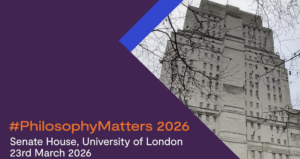
The Court Room, Senate House, School of Advanced Study, University of London WC1E 7HU
A video of this event is now available
#PhilosophyMatters for Public Policy
14:00 – 15:00
Presenter and broadcaster Ritula Shah chairs a panel discussion with Quassim Cassam, Barry Smith and Heather Widdows. Quassim, Barry and Heather routinely take philosophical research beyond academia. They are ‘go to’ experts in their topics, frequently asked for advice and comment by policy-makers, industry, NGOs and the media. Quassim works on terrorism and foreign interference and has written on the UK’s definition of terrorism with Jonathan Hall KC, the Independent Reviewer of Terrorism Legislation. For the last 10 years, he has also been running training sessions on professional virtues in general practice for trainee GPs in Manchester. Barry works on the senses, with clinicians, neuroscientists and patient groups on taste and smell, and has advised industry and driven public debate on ultra-processed food. Heather works on body-image, body modification and lookism, has advised policy-makers and worked with the anti-bullying alliance.
#PhilosophyMatters in the Food Chain
16:00 – 17:00
Suki Finn, Tessa Ditner Amorosi, Barry Smith
Philosophers are increasingly turning their attention to food and tasting, exploring a variety of philosophical themes. It is a widely held view that taste is subjective. But is that true? How does tasting differ from the other senses and how is it enhanced by what we see, smell, hear or touch? Food is an aesthetic object, a metaphysical object, a sensory object, a chemical object, a cultural object, as explored in Suki Finn’s book, What’s in a Doughnut Hole? How important are the words we use to describe foods? Can they mislead us? How do advertisers capture the properties of food and experiences of it? What are foods and what are not foods? Tessa Ditner Amorosi explores the conceptual and political issues surrounding foods. Barry Smith looks explores our experience of food and flavour and the surprising factors that shape it.
#PhilosophyMatters to AI
17:30 – 18:30
Alex Gzrankowski, Murray Shanahan, Winnie Street and Geoff Keeling
More than ever, pioneers at the frontier of AI are turning to philosophers to examine the notions of intelligence, understanding, agency, truth and trustworthiness. The responsible development of generative AI has become an urgent concern, and the practicalities or aligning AI systems with human values is a live issue. A panel of philosophers, AI engineers and experts from the Institute of Philosophy, Google DeepMind and Google Research will consider where we are now.
#PhilosophyMatters to the Public
19:30
An audience with Nigel Warburton and David Edmonds. Nigel and David are two of Britian’s best-known philosophers who share a commitment to popularising philosophy and engaging in the public sphere. Both have authored popular and best-selling books. Nigel’s include A Little History of Philosophy, Free Speech: A Very Short Introduction, and Philosophy: The Basics, and David’s include, Would You Kill the Fat Man? and Death in a Shallow Pond. Both appear regularly in the media and Nigel has a weekly column in The New World (formerly The New European) and David is an ex-BBC radio documentary maker and has published widely across the British press. Together they run one of the foremost philosophy podcasts, Philosophy Bites, which has had over 50 million unique episode downloads. Nigel and David are active ambassadors for the discipline, showing that philosophy changes what and how we think.
PLEASE SEE INFORMATION ABOUT ALL
#BPF2026 EVENTS HERE
UWE Philosophy – student contributions to #BPF2026
Student-led contributions to British Philosophy Fortnight received at UWE Philosophy including a range of original artwork, blog posts, and a video.
CLICK HERE
Simon Kirchin, Director of the British Philosophical Association, introduces British Philosophy Fortnight.
What?
British Philosophy Fortnight is a new annual initiative to celebrate, promote and champion philosophy.
We are raising awareness of what philosophy is and why it matters. Philosophy matters intrinsically, as a vibrant intellectual discipline, and extrinsically, providing crucial skills for living in complex worlds and for responding to pressing global challenges, from pandemics to climate change.
Why?
Philosophy is an exciting subject, which provides the skills to think big, to question why things are the way they are and to ask how they should be. Philosophy is a broad discipline, with elements of STEM (logic and philosophy of mind), social science (political philosophy and ethics), and humanities (aesthetics). Studying philosophy provides key skills which employers value. Studies in the US show that philosophy graduates are employed at a similar rate to business graduates (Career Success Point 1 – Study the Humanities) and, when considered over time, earn more than business graduates (Career Success Point 3 – Study the Humanities). That philosophy is exciting and provides skills for future success is shown by the fact that students continue to vote with their feet and choose to study philosophy (HESA table 52).
Studying philosophy, whether in formal education or informally for personal interest, improves understanding of complex issues and increases well-being. The Philosophy Garden is aimed at the students in primary and secondary schools. SAPERE provides resources for teaching children from the early years onwards. The Association of Philosophy Teachers supports a vibrant community for teaching older children and young adults. Studying philosophy improves lives, and is taught in prisons and in communities, as well in traditional teaching spaces such as schools and universities.
Philosophy complements other disciplines and methods of inquiry. For instance, philosophers of mind are working with AI companies to develop new technologies, and to imagine how human beings will transform in light of such changes, as well as to think about the benefits and threats of such developments. Philosophers are also working with policymakers, to determine how to improve well-being and to distribute resources in times of scarcity. Very few questions can be addressed by science alone. Even initiatives that seem scientific, for example, developing vaccines to respond to deadly pandemics, need philosophy. Science can develop a vaccine, but it can’t tell us how to distribute it. Should it be given first to the most vulnerable, those most likely to die, or perhaps, to the most valuable, those who will ensure the survival of the human race, such as healthcare workers or food producers, or should we allow those who can afford it to purchase it? These are philosophical and ethical questions.
Philosophy is invaluable when hard choices have to be made, and philosophers routinely partner with policy-makers, industry, NGOs, and activists to ensure strategies and initiatives are well designed, and without disastrous unintended consequences. To learn more about how philosophy makes real world difference see our pages on the Impact of UK Philosophy.


